


Storm Tree Risk and Safety Assessment

Updated: Feb 23
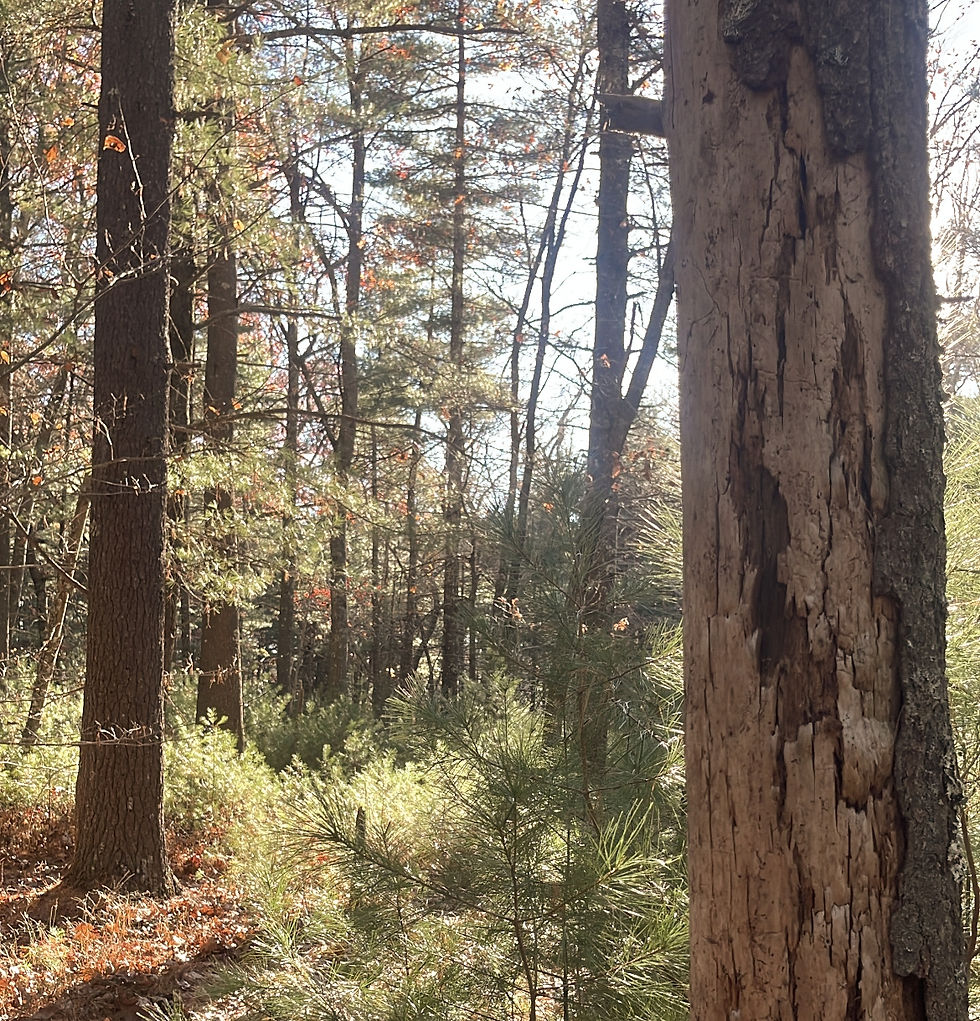
A hollow tree does not automatically mean neglect, nor does age alone decree collapse. In the living world of trees, hollowness can be a chapter, not the final sentence. Many trees form hollows as a natural response to time, injury, pruning wounds, or old storms; decay enters the heartwood, which no longer carries water or nutrients, while the outer layers, the sapwood and cambium, continue their sacred work of circulation and growth.
Like a seasoned elder with scars that tell stories rather than signal weakness, a hollow tree can still leaf out vigorously, flower and bare fruit, provide shade, shelter wildlife, and anchor itself safely when its outer shell remains strong and proportionate to its height and canopy. Arborists often look not only at the hollowness but at the thickness of what remains, measuring whether the living wood is enough to bear the loads of wind, snow, and gravity, much as an engineer evaluates whether a bridge with visible wear can still carry traffic.
In forests, hollow trees can stand for centuries, cradling owls, squirrels, and bees, proving that life often thrives in spaces once thought ruined. Yet when it comes to evaluating the risk of failure in trees within a yard or near a road or sidewalk requires discernment. A hollow tree near homes, walkways, or play areas carries a different responsibility than one deep in the woods. When decay advances too far, when the remaining shell is thin, cracked, or compromised at the base, the tree looks less like safety and more like danger. It might still look upright, but vulnerable to the slightest gust. Safety is not about fear of imperfection but respect for limits; a tree that leans heavily, sheds large dead limbs, or shows fungal growth at its roots may be quietly signaling that its strength is failing.
Removal, in those cases, is of protection. The true answer is not found in a simple yes or no, but in thoughtful evaluation: some hollow trees are resilient survivors, carrying life forward despite their wounds, while others have reached a point where letting go is the most responsible choice. The art lies in knowing the difference, honoring the tree’s story, weighing its risks, and deciding whether it can safely continue standing as a testament to endurance, or whether it should be laid to rest so that new growth, light, and safety may take its place.
Seen through this same lens of respect and responsibility, a hollow tree invites us to slow down and listen rather than rush to judgment. It asks the same question life often does: is strength defined by what is missing, or by what still remains and how wisely it is supported? A hollow trunk may look like absence to the untrained eye, but to those who understand trees, it can represent adaptation, a tree redirecting its energy, reinforcing its living ring year after year, thickening its walls like a potter shaping clay around an empty center. In this way, the tree teaches a quiet lesson in resilience. Survival is not about being untouched, but about responding well to what surrounds us as the wound heals. Wind still moves through its branches, leaves still catch the sun, and roots still converse with soil and stone, reading the language of moisture and holding fast.
As long as these trees are not a risk to your property and your neighbor's as well as others walking nearby, it's up to you to make the final decision whether you're keeping it or hiring a tree care professional to make sure the removal process it's done safely.
When it come to trees, time continues its work whether we watch closely or not. Fungi, insects, moisture, and gravity all negotiate with the tree daily, testing its resolve. What matters is not that decay exists, but whether decay has begun to outpace defense. A hollow high in the trunk may be far less concerning than decay at the base, where leverage is greatest and failure most unforgiving. A tree may look safe on a still afternoon, yet reveal its condition during a winter storm or a heavy snowfall. In this sense, a hollow tree is like an old house with creaking floors, you don’t condemn it for its age, but you do inspect the beams before inviting others inside. Wisdom lives in assessment, not assumption.
There is also a moral dimension to this choice, especially in human landscapes where trees share space with homes, streets, and lives. Allowing a compromised tree to remain where it poses real danger is not an act of mercy; it is neglect disguised as hope. This kind of work asks for trained eyes, honest measurements, and the humility to accept what the tree is telling us rather than what we wish were true. Sometimes the most respectful act is preservation, careful pruning, load reduction, monitoring, and allowing the tree to continue its role as shade giver, habitat, and living witness to time. Other times, the most loving act is removal, transforming the tree’s final chapter into firewood that warms homes, mulch that feeds soil, or space where younger trees can grow and thrive.
Even in removal, the story does not end. A tree that is taken down safely and intentionally continues its service in other forms, returning its stored energy to the cycle it came from. In this way, no decision made with wisdom is wasteful. Whether standing or falling, the tree still teaches us about balance, between beauty and risk, reverence and responsibility, emotion and evidence. Hollow trees, perhaps more than any others, remind us that life is rarely solid all the way through, yet still capable of meaning, usefulness, and grace. The question is never simply whether a tree is hollow, but whether it is still whole enough structurally, situationally, and safely to remain part of the living landscape. When we learn to answer that question carefully, we honor tree care professionals and trust their opinion and advice.
If you reside in Massachusetts, the first snowflake settles like a warning on your roof, the trees around your home are already holding a quiet conversation with gravity. From the outside, they may look strong, but some carry hidden chambers within, hollowed trunks carved by time and decay may in winter, snow is not gentle; it is weight stacking on branch by branch until even the strongest limbs begin to bow. Evergreens, dressed year round in needles, act like open hands catching the flakes, every ounce, until the burden becomes more than wood and fiber can bear. A hollow trunk may stand tall in fair weather, yet under snow’s steady pressure, it can fail suddenly, like a roof beam giving way without warning. This is why a tree care professional should walk your property before winter arrives or during the winter to read your trees the way a doctor reads an X-ray, tapping, inspecting, diagnosing what the untrained eye cannot see.
Strategic pruning becomes a form of mercy, thinning dense evergreen crowns so snow slides away instead of settling in, relieving branches before they snap and fall toward homes, cars, and lives below. To ignore this preparation is to trust chance with your safety, hoping that weight, wind, and weakness will negotiate kindly. But trees, like people, need guidance and care to endure harsh seasons. Inviting a professional to assess and prepare your trees before a snowstorm is not an act of fear; it is an act of wisdom, one that turns winter from a threat into a season where your trees can survive with grace and strength.
Some winters can be harsh on our trees more than others, and when Spring comes there's much more work to do to help them thrive. If our trees are already diseased, weak, have shallow roots and/or are hollow the chances are that they won't be resilient enough through a bad storm. In most cases, even if they are strong enough to withstand the winds, they could take advantage of a safety and risk assessment before a new season arrives, specially because Spring is rain season.
Do you have trees that may need to be seen by a tree care professional during the winter?
Contact us to schedule a free risk check consultation.


Comments